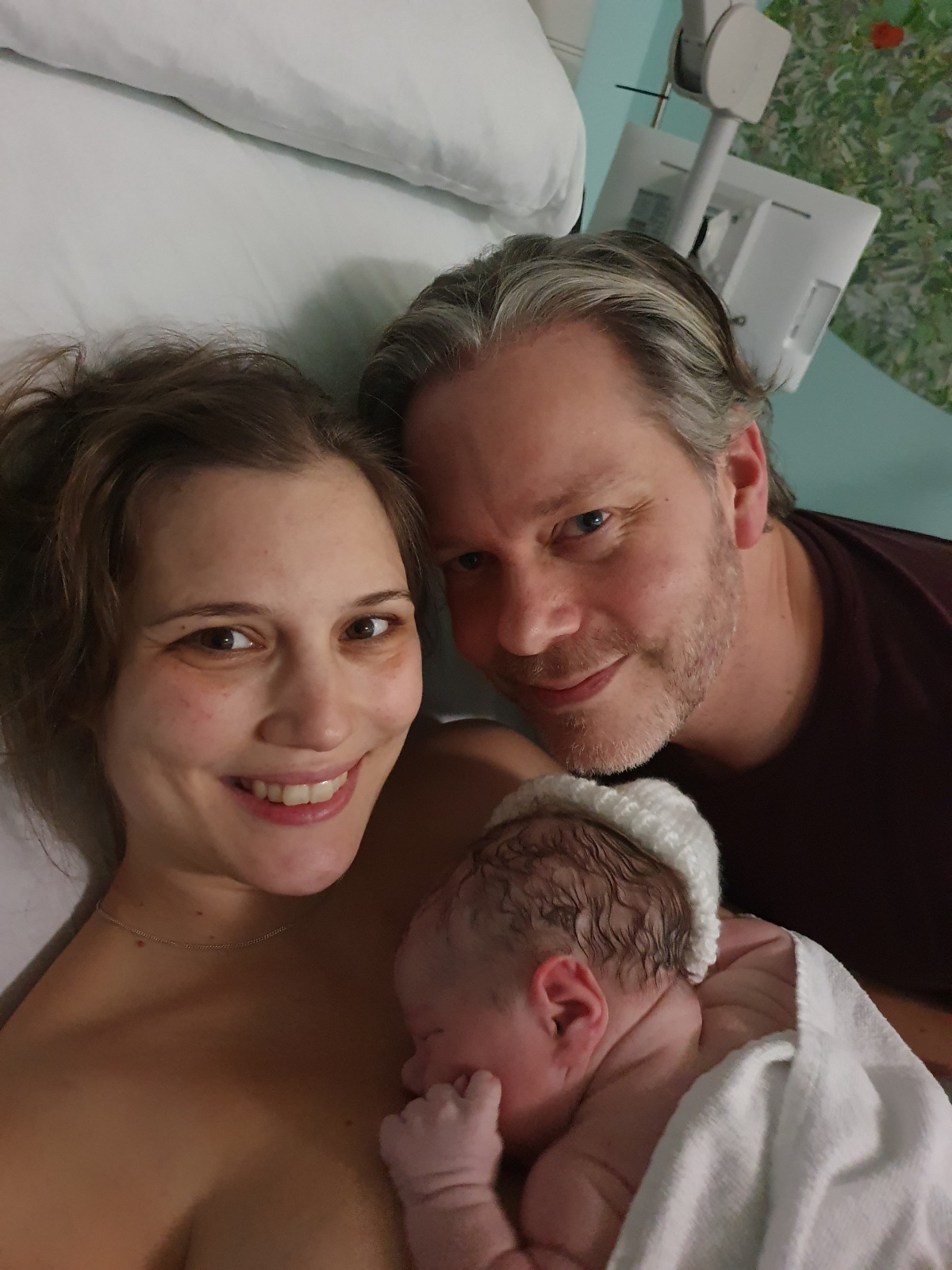
Recently a new mother got in touch with the OptiBreech team and was keen to share her story and experience with others.
We welcome all feedback and experiences as they can be so useful to understand how OptiBreech research is being utilised by the public.
“We all know no two babies are the same, so it came as no big surprise that my two pregnancies should not be the same. Most notably, baby #2 decided – sometime around week 23 – to make itself comfortable in a breech position. Following an additional scan during week 33, he was settled in footling breech, and I started working on all the advised exercises to help encourage him to flip. I did daily pelvic inversions, daily pelvic tilts, had 2 appointments for an ECV with a total of 3 consultants trying their luck – but nothing would move him out of his breech presentation. Ironically, it wasn’t the bum that was the difficult part during the ECV, but rather his head did not want to move away from between my ribs. So, we faced the cold reality of what a breech presentation means these days, particularly in Scotland and at the Forth Valley Royal Hospital: doctors telling us that their best advice is to schedule an elective caesarean section, mostly determined bythe sheer lack of properly trained personnel for vaginal breech births ever since the Term Breech Trial of 2000. But no thank you! This was my last baby, my last pregnancy, and my last birth. And after my first delivery ended up rather differently from what I had anticipated (induction, epidural, forceps, episiotomy – all things I wished to avoid), this was my last and only chance to use my prior experience and for this time to “get it right”. I wanted to go into labour on my own terms. I wanted to deliver vaginally. I wanted to deliver without an epidural to be able to remain mobile… So this breech position presented an issue. And as far as we were told only 2 consultants at this hospital were experienced with vaginal breech deliveries, but their working schedules were unknown as we approached the Christmas holidays. Thankfully, the doctors allowed us plenty of time to make an informeddecision and reassured us they would support any of our choices, as long as we are fully aware of all the associated risks. My main consultant was even happy for me to go past my due date by about 12 days for a scheduled section, which was a little surprising.

At 39 weeks I was booked in for a growth scan and to check baby’s position again. We were in complete breech and the measurements estimated a foetal birth weight of more than 4kg (weight at 39 weeks was estimated to be 3946g). Risks to baby of a vaginal delivery were highlighted again, particularly should the foot end up presenting first. By that point, I had done a ton of research and reading around vaginal breech deliveries and found the Breech Network an invaluable resource. I had also started hypnobirthing exercises to help me prepare for a calm and relaxed labouring process and birth, whichever way it would end up.
Once I approached my due date, I worked hard to help kick start my labour for two reasons: 1 – my mum was visiting from Germany for a week to hopefully meet her second grandchild, and 2 – because every day this baby was getting a little bit bigger, making a natural delivery less and less likely. I was doing hip circles on my birthing ball, lunges and squats, curb walking, sideways stair climbing, nipple stimulation and colostrum harvesting, sex, clary sage oil massages, acupressure, the lot. I was also booked in for 2 membrane sweeps, but neither happened as baby’s bum was not engaged and sitting on my pelvic brim, thereby posing a danger in case the midwife broke my waters during the sweep. However, one highly experienced midwife offered to at least do an internal examination to see whether anything was happening yet at all. She determined I was about 2-3cm dilated, could feel a foot at the cervical opening and only offered a very gentle cervical stretch, which went well. That evening I felt some tighteningsand was hopeful that this was the “push” needed to get labour started. However, the following day the tightenings had stopped almost completely, which was a little disheartening. The next day, I knew there were tightenings present, but they were rather unnoticeable, particularly during periods of activity or distraction. So at night, after my toddler was finally sound asleep, I decided to spend an hour of quiet time to observe my tightenings. I put on my hypnobirthing app and relaxation soundtrack and used the contraction timer to monitor frequency and duration of each tightening (which at this point I could only really feel when I placed my hand on my bump). As it turned out I had about 3 contractions in 10min, each lasting 80-90sec. I phoned maternity triage for advice given my situation and they asked us to come in for a check-up. Once we had childcare for the night in place, my husband, mum, and I drove to the hospital. The exam determined I was still only about 3cm dilated and that the foot was still the first presenting part. That said, the midwife said I would be okay to head home for a while longer, a decision that was quickly overturned by the consultant on shift that night who realised the risks of a cord prolapse with a footling presentation should my waters break en route or at home. So I was admitted and we spent the night – husband and mum sleeping uncomfortably in a chair and on the floor padded with jackets, and me with increasing “period pains”. By the morning I knew I was in early labour!
I met the relatively young consultant who was on shift that day and he reassured me that he would be around for the next 24 hours and that he is comfortable with vaginal breech deliveries and has carried out a few of them. After reminding us of the current risks of my baby’s presentation and estimated weight, along my decision to want to deliver vaginally, we agreed that the ultimate decision would be made at the point when my waters break – if baby’s bum is low enough I would be allowed to carry on, and if it wasn’t I would be taken to theatre for a section immediately. We agreed and all necessary precautions (cannula, meeting the anaesthesiologist) were taken. He even offered to attempt a third and final ECV to which I agreed, but it clearly did not work.
During the day, I continued to labour with the help of my breathing exercises, the hypnobirthing relaxation soundtracks, movements, a couple of Paracetamols, and some intense pelvic counterpressure applied during each contraction by my two birth partners. I was able to keep going right until the moment I felt the need to push. The consultant gave me a quick examination and determined that I was fully dilated and still with a foot coming first. During my third contraction with pushing my waters finally broke (exploded!) and his little foot popped out. Another quick examination determined that thankfully the bum was low enough for me to continue on my path and the consultant only helped deliver the second foot before remaining “hands off”. As baby descended on its own, I could feel his legs flexing as I knew breech babies do during delivery, but the pain I experienced during those movements was intense and felt like someone was tugging and pulling him, further exacerbating the pain. I was on my 4s and reminded myself of the breathing techniques I learned from my hypnobirthing practice and the research I read on the Breech Network website (down-breathing and cyclic pushing). I knew time was of the utmost essence, so I remained focussed through the pain to make each push count and to get this baby delivered as quickly as I can. Halfway through the birth I was asked to switch onto my back and to move onto another bed, a task which seemed utterly impossible at the time with the labour pains and the lack of mobility as half of my baby was already born. But the move was important to flex and deliver his head, and so everyone helped me into my new position. Once on my back I reached down and could feel my baby’s floppy body. The consultant informed me that he is going to help deliver the arms, which were stretched up by the head. He managed to get the arms out and I felt an immediate and welcomed relief of the ring of fire. This was the final moment. Time had ticked on and the largest part had yet to be born. My husband told me that during the next push the head started to emerge, but retracted back into the birth canal as the cord was wrapped around his neck 3(!!) times – no wonder he didn’t flip around!
I was asked to give a really big push with my next contraction, but because I hardly felt or noticed my contractions during the whole delivery, I instead got myself mentally and physically ready and in my own time started afinal long and strong push. Birthing the head felt like a big ‘pop’ and an immense feeling of pain relief, exhaustion, and zen.
My baby’s cord was clamped and cut straight away (apparently the cord was stretched and white/compressed during a large proportion of the birth and tore during the delivery of the head) and he was taken to the resuscitation trolley to get his breathing started. He was quite stunned, blue and floppy and it took a little while to bring him back (APGAR score of 2 at 1min – heart sounds only; 6 at 5min) but the paediatricians knew what to do and did a great job. From my waters breaking to him being fully born took a total of 11 minutes (even though it felt a lot longer to me), and he was weighed at a proud 4165g.
We stayed in hospital for about 28 hours and Elliott took his first feed on the breast after a good 6-hour recovery nap. He passed all his exams and tests and is a healthy and thriving baby.
I am so immensely grateful to have had this particular birthingexperience and I feel incredibly proud of not only what I achieved, but also for believing in myself and nature, sticking to my beliefs within the realms of safety for me and the baby, and to remain strong in the face of the potential risks. I owe a big part of this to the information available from the Breech Network and the birth preparations and positive affirmations provided by the Positive Birth Company. I don’t know how many times or how many medical staff I told that if no one is willing to give vaginal breech births a chance, how are the doctors and midwives ever going to get these skills back?”
— Sandy MacMillan

 OptiBreech